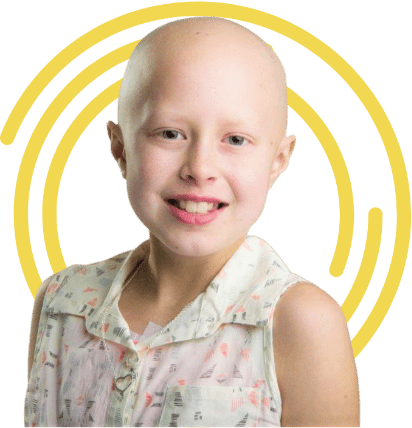
Stories of progress, inspiration, and information in overcoming osteosarcoma.

Osteosarcoma survivor Andrea Helfer in front of a presentation of her research.

The Long Horizon of Survival: Andrea’s Story

Andrea Helfer offers a firsthand account of how she finds hope while acknowledging that osteosarcoma survivorship can be a lifelong challenge.

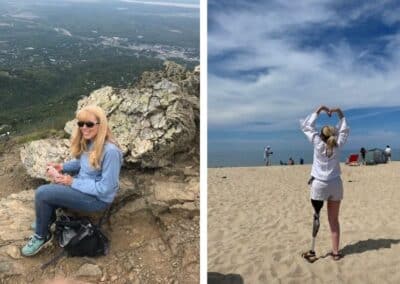
More than 30 years after surviving childhood osteosarcoma and with limited mobility, I still think about every step I take. Each day involves small but deliberate decisions: how I structure my time, what activities matter most, and how to use a limited “step budget” wisely. It is the discipline of someone who has spent most of her life walking on a limb constructed from metal learning over time how to balance use, preservation, and quality of life.

In 1990, I was 8 years old and growing up in Germany when osteosarcoma was found in my femur near the knee. Treatment options were stark. At that time, children with tumors of that size were often treated with amputation or rotationplasty.

One of my physicians in Munich had recently learned about an innovative limb-salvage approach from Vienna, Austria, four hours away. Surgeons there were using a modular reconstruction designed to replace large sections of bone removed during tumor surgery. This endoprosthesis could be lengthened as a child grew, allowing the preservation of the limb while maintaining alignment over time.

In the early 1990s, the technique was still relatively new and long-term durability unknown. Still, my family decided to pursue it, despite all the administrative burdens that came with cross-border treatment at that time.

Learning to Walk Again

As I woke after the tumor resection and prosthesis implantation surgery, I remember one sensation clearly: My leg felt impossibly heavy.

Over the following years, I underwent several more operations in Vienna as surgeons lengthened the prosthesis to keep pace with my growth, along with plastic reconstruction and managing complications. Through one year of chemotherapy and roughly two dozen surgeries in the following years, my mother never left my hospital bed.

After one of those childhood surgeries, I started walking at home with my father, who held my  hand to steady me. Together we counted the steps I could take. One step, then another. The numbers were small at first, but every day, they grew.

Looking back, I remember being both strong and fragile during those years; strong because the medical routine became part of everyday life, fragile because every improvement required patience and persistence and came with risk. I was also navigating how others perceived me – my leg visibly different after many surgeries, muscle grafts, skin grafts, and my mobility changing from one phase to another, sometimes on crutches, sometimes not. It raised questions and whispers behind my back, among other children and adults, about what it meant to be “sick.” It also meant adapting to how my body looked, learning, over time, to live with visible differences and how others responded to them.

As I grew, the prosthesis was lengthened several times to keep my legs aligned, but it meant missing school and enduring many hours of rehabilitation in between surgeries. Eventually, the surgeries became less frequent as my growth was completed, but revision surgeries were still to follow.

The reconstruction allowed me to build a life with mobility beyond illness, but I also understood something early on.

No prosthesis lasts forever.

When the Past Returns

For many years, my leg performed remarkably well. I studied, entered public service, and built a career in government, working in complex policy environments where long-term thinking and resilience were essential, skills I had developed early in life.

Then, decades after my original surgery and eight years since my last surgery, the past resurfaced. I experienced a fracture in the reconstructed limb. The injury was unsettling not only because of the pain, but because of what it suggested. The reconstruction had already been large and technically demanding when it was implanted. It replaced an entire joint, part of my tibia, and a significant portion of my femur, a so-called mega prosthesis, with surrounding tissue also resected. If something of that scale begins to fail, the options are not simple.

Replacing such a prosthesis is not a straightforward exchange. The reconstruction is technically complex and medically demanding. In that moment, I once again confronted the long reality of survivorship.

When the fracture happened, I contacted my longtime surgeon in Austria, and same day emergency surgery was initially planned. However, delays related to insurance approval meant I could not be transported to Vienna until several very painful days later, leaving me in fear of whether a limb salvage would still be possible.

It was, but the surgery resulted in a total femur replacement. This marked a turning point: No more walking independently without crutches, no sitting for extended periods of time, and I now had to contend with secondary shoulder issues.

Still, I tried to return to my previously built life, but I eventually had no choice but to take a medical retirement and move away from Berlin, Germany’s capital and my place of work, to Bavaria in the south of Germany to be closer to family and rebuild my life. This required a fundamental redesign of daily life to fit my new mobility needs.

Today I work in executive coaching, holding active consulting and advisory roles. In this work, I draw on lessons shaped by long-term adversity, particularly how to make decisions and adapt when uncertainty is not temporary, but sustained over time.
“I see survivorship not simply as the absence of cancer; it is the long-term work of managing function and risk over decades while continuing to build a meaningful life within those constraints.” —Andrea Helfer

The Work of Living Well

People often imagine cancer treatment as a defined chapter: diagnosis, therapy, recovery, and then life returns to normal (or, rather, a new version thereof). For survivors who undergo complex orthopedic reconstruction, the story is longer and often does not have a clear endpoint.

Bones age. Implants wear. Mechanical systems must endure decades of stress. Survivorship becomes a careful balance between activity and preservation.

I approach this reality with the mindset I developed as a child. Every unnecessary step has a cost. Every physical decision matters. Over time, this became a way of thinking more broadly about trade-offs: when constraints are real and cumulative, small decisions carry weight.

But these constraints have also shaped how I think about life. Rather than focusing on my limits, I focus on designing a life that works within them, often discovering possibilities I might otherwise have overlooked. Over time, I’ve come to see these constraints not only as limitations, but as something that requires clarity, forcing more deliberate choices about what matters.

I think of the term “ticking time bomb,” as one physician called my tibial fixation many years ago. Over decades, the forces transmitted through the implant have gradually thinned the surrounding bone. The risk is not abstract: If the wrong stress is placed on the area, another fracture could occur, requiring complex revision surgery and likely resulting in further limits to mobility.

For me, survivorship means living with uncertainty. It is not only about day-to-day decisions, but also about longer-term questions, like how long a reconstruction will last, and whether more radical interventions may eventually become necessary.

But my understanding of that risk has evolved. This year marks 10 years since my last surgery. That’s the longest surgery-free stretch of my life. The risk is still there, but I’ve learned that risk doesn’t always become reality.

That shift has become one of the most important lessons of my survivorship: the possibility of future problems remains, but so does the evidence of stability. Living with uncertainty means holding both realities at once.

I see survivorship not simply as the absence of cancer; it is the long-term work of managing function and risk over decades while continuing to build a meaningful life within those constraints.

Cancer treatment lasted one year. Living with its consequences has lasted more than three decades. I don’t necessarily welcome the challenges, but I recognize them in the context of something larger: I am fortunate to be here to face them. That sense of gratitude does not remove the difficulty, but it often makes it feel more manageable.

The Long Path Forward

Today, research continues to improve treatment for children diagnosed with osteosarcoma. I know firsthand that the innovations developed today will influence how survivors live decades from now.

Drawing on my own experience, I’ve been developing a longitudinal survivorship framework for complex osteosarcoma childhood survivorship and recently presented this work at the European Society for Medical Oncology Sarcoma and Rare Cancers Congress, contributing a long-term perspective from one of the earliest cohorts of children treated with limb salvage.

I think back to those days at home after childhood surgeries, when my father and I counted each step I could take. One step, then another.

At the time, those small numbers marked the beginning of recovery. Decades later, they represent something larger: the long path made possible by medical innovation, determination, and hope.

For children facing osteosarcoma today, that path is still being built one step at a time.

Decades later, I have come to understand that the path does not end with treatment. For some of us, it continues through reconstruction, adaptation, and the ongoing management of uncertainty.

There is still a future beyond treatment. I’ve learned that it may not look the way we once imagined, but it is still there. It is, in a way, a different kind of light at the end of the tunnel.

Sign Up to Receive The Frontline

Stay informed as we work to identify new treatments for osteosarcoma.

We never sell or share your information.

Contact Information

More On This Topic

No results found.

Your donation provides immediate and long-term support to osteosarcoma patients.